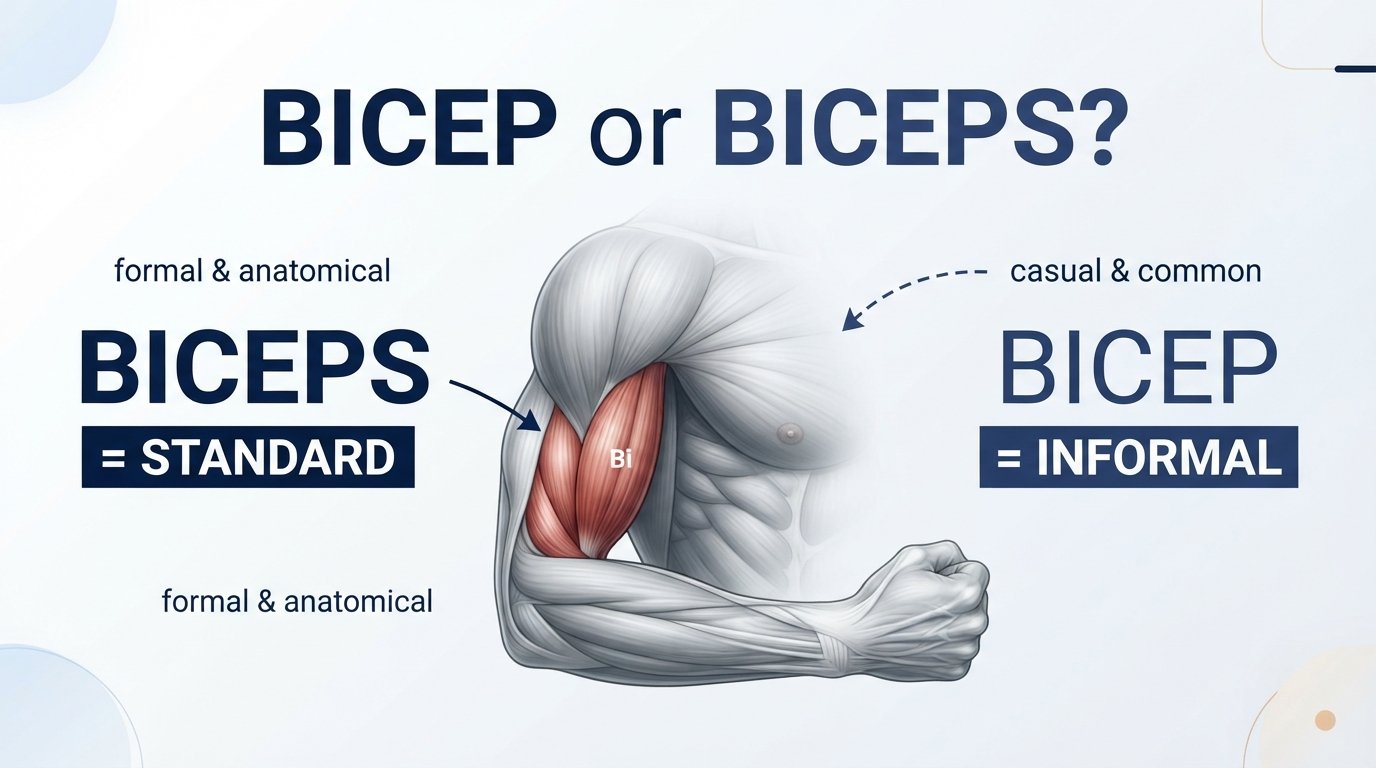
Have you ever wondered whether the muscle in your upper arm is called a bicep or biceps? Both forms are used in English, but “biceps” is the standard anatomical term, while “bicep” is a common everyday singular form.
The muscle is formally called the biceps brachii, and the word biceps is commonly used even when referring to the muscle in one arm. For example, you might say, “He injured his biceps while lifting weights,” or, in everyday conversation, “I strained my bicep.”
This can be confusing because biceps looks like a plural word, even though it is also used as the name of the muscle. If you’re searching for bicep or biceps, you may want to know which form is grammatically correct, which one is preferred in anatomy, and whether bicep is actually a mistake.
In this guide, you’ll learn the difference between bicep and biceps, understand their usage, see clear examples, and discover which form fits formal and everyday English.
Bicep or Biceps
Biceps is the standard anatomical term for the muscle at the front of the upper arm. Bicep is a common informal shortening of that word.
So, neither form is simply a random spelling mistake.
The quick rule
- Biceps = standard and more formal term
- Bicep = common informal form
- Biceps is preferred in medical and anatomical writing
- Bicep is common in casual speech and fitness language
- There is no major British-versus-American spelling difference
- Biceps can refer to one muscle or to the muscles of both arms, depending on context
Examples
Formal or anatomical:
The biceps is a muscle in the upper arm.
Casual:
My bicep hurts after my workout.
Talking about both arms:
My biceps are sore today.
Fitness:
This exercise targets the biceps.
Bicep vs. Biceps at a glance
| Word | What it means | Best use |
|---|---|---|
| Biceps | Standard name of the muscle | Formal, medical, academic, and general writing |
| Bicep | Informal shortened form | Casual speech, social media, and informal fitness language |
If you are unsure which one to use, choose “biceps.” It is the safer and more standard form.
The Origin of Bicep and Biceps
The word biceps comes from Latin.
It is based on two parts:
- bi- means “two”
- caput means “head”
Together, the word refers to something with two heads.
This name describes the structure of the biceps brachii, the muscle found at the front of the upper arm. The muscle has two main heads:
- the long head
- the short head
These two parts join to form the biceps muscle.
Why does biceps end in “s”?
The unusual ending is one reason people search for “bicep or biceps.”
The -s does not simply mean that the word must be plural in English. The word comes from Latin anatomical terminology and keeps its traditional form.
That is why biceps can be used as the name of the muscle even when referring to one arm.
For example:
The biceps is located at the front of the upper arm.
When talking about both arms, you can naturally say:
Both biceps are sore after training.
Why is “bicep” used?
Over time, English speakers shortened biceps to bicep in everyday language.
Shortened forms are common in informal English. People often prefer words that are quick and easy to say.
This is especially noticeable in fitness language.
You may hear or see:
- bicep workout
- bicep curl
- bicep exercises
- bicep training
- bicep pain
These expressions are widely understood.
However, biceps remains the standard form when precision and formality matter.
Is Bicep Singular and Biceps Plural?
This is the part that causes the most confusion.
A simple way to understand it is to separate informal everyday English from the standard anatomical term.
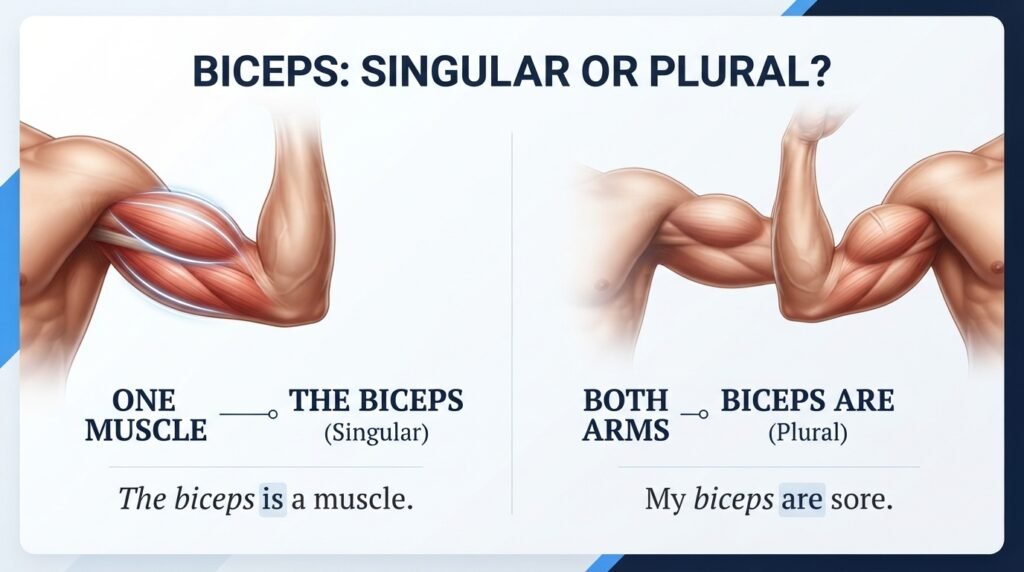
When talking about one arm
In casual English, people commonly say:
My bicep hurts.
Here, bicep is being used as an informal singular form.
In anatomical or formal writing, you may see:
The biceps is a muscle of the upper arm.
Here, biceps is being used as the name of one muscle.
When talking about both arms
When you mean the corresponding muscles in both arms, biceps is commonly used with a plural verb:
My biceps are sore after the workout.
Another example:
Both of his biceps are well developed.
The easiest rule
If you want simple everyday wording:
One arm → bicep is common in casual speech.
Both arms → biceps is common.
If you want formal or anatomical wording:
Use biceps, and let the sentence show whether you mean one muscle or both.
This explains why biceps should not automatically be treated as a normal plural word just because it ends in -s.
Simular or Similar: Similar Is the Correct Spelling
British English vs American English Spelling
There is no major British-American spelling difference between bicep and biceps.
Both British English and American English use biceps as the standard anatomical term. Both also use bicep as an informal shortened form.
| Usage | American English | British English |
|---|---|---|
| biceps | Standard | Standard |
| bicep | Common informal form | Common informal form |
| biceps muscle | Common | Common |
| biceps brachii | Standard anatomical term | Standard anatomical term |
| bicep workout | Common in casual fitness language | Common in casual fitness language |
This means bicep vs. biceps is not like color vs. colour or theater vs. theatre.
There is no rule saying that Americans must use one form and British speakers must use the other.
The main difference is formality and context, not country.
What about Canada and Australia?
The same basic pattern applies in other varieties of English.
Biceps is the standard term, while bicep is commonly used in informal contexts.
For global English, biceps is the safest choice because readers will recognize it easily in medical, educational, and fitness contexts.
Which Spelling Should You Use?
The right choice depends on who you are writing for and how formal the situation is.
For medical writing
Use biceps.
For example:
The biceps tendon connects the muscle to the bones of the upper arm.
Medical and anatomical writing should favor precise terminology.
For academic writing
Use biceps.
Example:
The biceps contributes to elbow flexion and forearm movement.
A formal paper or educational article should avoid unnecessary informal shortening.
For professional fitness writing
Biceps is usually the better main term.
For example:
These exercises target the biceps and help build upper-arm strength.
However, bicep can still appear naturally in fitness content, especially in common phrases such as bicep curl or bicep workout.
For casual conversation
Either can work.
You might say:
My bicep is sore.
Or:
My biceps are sore.
The first sounds more casual. The second uses the standard term.
For social media
Both forms are common.
Examples:
Bicep day 💪
Biceps workout complete!
Social media does not require the same level of formality as medical or academic writing.
For a global audience
Choose biceps when you are unsure.
It is the most standard and professional option and works well across different English-speaking audiences.
Skiddish or Skittish: Which Word Should You Use?
Common Mistakes with Bicep or Biceps
Several mistakes appear because the two forms look similar.
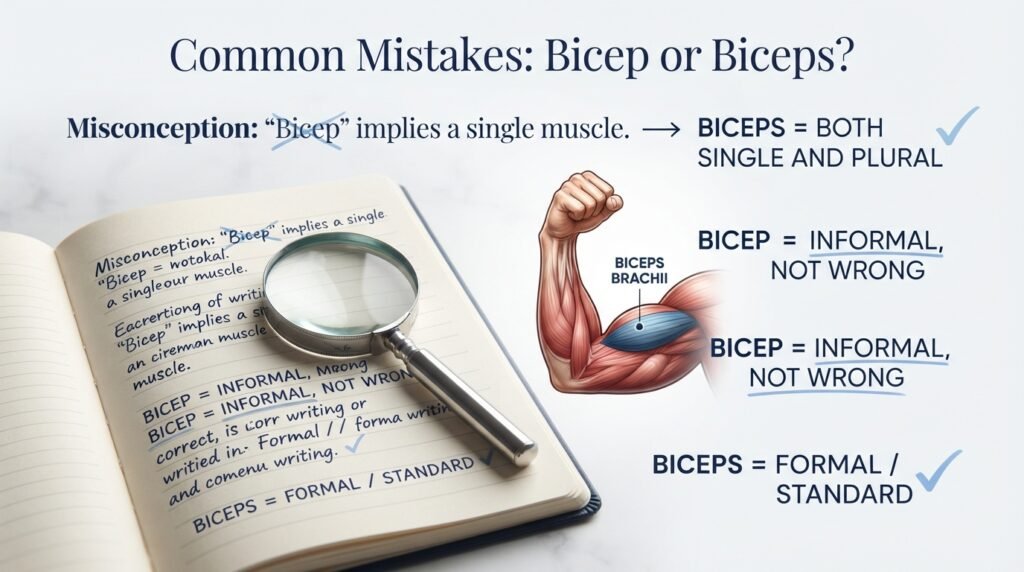
Mistake 1: Assuming “biceps” is always plural
The -s can make the word look plural, but it is not that simple.
Biceps is the standard anatomical name and can refer to one muscle.
Correct:
The biceps is a muscle of the upper arm.
When referring to both arms:
My biceps are sore.
Mistake 2: Assuming “bicep” is always wrong
Bicep is a real and widely used informal form.
It is especially common in casual conversation and fitness language.
Correct in an informal context:
I injured my bicep while lifting weights.
For a formal anatomical context, biceps is usually preferable.
Mistake 3: Writing “bicepses”
People sometimes assume that if biceps is singular, the plural must be bicepses.
That is not normally how the word is used.
For both arms, simply use:
My biceps are strong.
Not:
My bicepses are strong.
Mistake 4: Using “bicep” in highly formal writing
Although readers will understand it, bicep is less formal.
Instead of:
The bicep tendon was damaged.
A professional version would be:
The biceps tendon was damaged.
Mistake 5: Thinking biceps only means two arms
Biceps can refer to the muscle itself.
For example:
The biceps brachii is located in the upper arm.
The word does not automatically mean “both arms.”
Mistake 6: Confusing “biceps” with “biceps brachii”
Biceps is the common name.
Biceps brachii is the formal anatomical name of the upper-arm muscle.
So:
biceps = common term
biceps brachii = formal anatomical name
Bicep or Biceps in Everyday Examples
The best way to understand the difference is to see how each form works in real situations.
In emails
A professional email should normally use biceps.
I have been experiencing pain in my biceps after exercise.
A casual message could say:
My bicep is really sore today.
In news writing
Professional news writing may use biceps when discussing an athlete’s injury.
The athlete suffered a biceps injury during training.
This sounds more formal and precise.
On social media
Social media language is usually more relaxed.
Examples:
Bicep day 💪
New biceps workout today!
Both are natural depending on the writer’s style.
In fitness articles
Both forms appear frequently.
Examples:
Best biceps exercises for beginners
Try these bicep curls
Build stronger biceps
This bicep workout targets the upper arm
For a polished fitness article, biceps is usually the better main term, while bicep can be used naturally in informal phrases.
In formal writing
Use biceps.
Example:
Resistance exercises can strengthen the biceps and other muscles of the upper arm.
In casual conversation
Bicep is common when referring to one arm.
I hurt my bicep at the gym.
This sounds natural in everyday speech.
Bicep or Biceps – Search Trends and Common Usage
People search for both bicep and biceps, but the reason for the search can differ.
The term biceps is common in anatomy, health, sports, fitness, and educational content.
People may search for:
- biceps exercises
- biceps workout
- biceps anatomy
- biceps tendon
- biceps pain
- biceps muscle
The shorter form bicep is also common in casual and fitness searches.
Examples include:
- bicep workout
- bicep exercises
- bicep curls
- bicep pain
- bicep muscle
Is one more popular everywhere?
Not necessarily.
Search behavior can change by country, topic, age group, and context. Fitness searches may use bicep because it is short and conversational, while medical and educational searches often use biceps.
The important point is that both forms are widely recognized, but they do not have exactly the same level of formality.
For professional content, biceps is usually the stronger choice.
For casual fitness language, bicep can sound completely natural.
Bicep vs Biceps: Side-by-Side Comparison
| Feature | Bicep | Biceps |
|---|---|---|
| Standard anatomical term | No | Yes |
| Informal use | Very common | Common |
| Formal writing | Less preferred | Preferred |
| Medical writing | Less preferred | Preferred |
| Academic writing | Less preferred | Preferred |
| Fitness language | Very common | Very common |
| Casual conversation | Common | Common |
| Social media | Common | Common |
| British English | Used informally | Standard |
| American English | Used informally | Standard |
| Refers to upper-arm muscle | Yes | Yes |
| Best general choice | Casual contexts | Most contexts |
Common phrase comparison
| Phrase | Recommended form | Why |
|---|---|---|
| ___ workout | Biceps workout | More standard |
| ___ curl | Biceps curl / bicep curl | Both are widely used |
| ___ exercises | Biceps exercises | More formal |
| ___ muscle | Biceps muscle | Standard phrase |
| ___ injury | Biceps injury | More professional |
| ___ pain | Biceps pain | More formal |
| ___ tendon | Biceps tendon | Standard anatomical wording |
| Strong ___ | Strong biceps | Natural general use |
| My ___ hurts | My bicep hurts | Natural casual singular |
| My ___ are sore | My biceps are sore | Natural when referring to both arms |
What Is the Biceps Muscle?
The biceps brachii is the muscle located at the front of the upper arm.
It has two main heads:
- the long head
- the short head
These heads work together during several movements of the arm and forearm.
The biceps helps with elbow flexion, which means bending the elbow. It also helps with supination, the movement that turns the forearm so the palm faces upward.
This is why exercises such as curls are strongly associated with biceps training.
In everyday fitness language, people may simply call the muscle the bicep. In anatomical and professional writing, biceps or biceps brachii is more appropriate.
Biceps Pronunciation
Biceps is usually pronounced:
BY-seps
Bicep is usually pronounced:
BY-sep
The pronunciation is simple once you know that the c has an s sound.
Example
I trained my biceps today.
Pronunciation:
“I trained my BY-seps today.”
For bicep:
“I trained my BY-sep today.”
Is “Bicep” Better for One Arm?
In casual English, bicep is often used when someone means the muscle in one arm.
For example:
My right bicep hurts.
This is natural and easy to understand.
In formal anatomical writing, however, you can still use biceps:
The biceps of the right arm is injured.
For everyday readers, the first version sounds much more natural.
So the practical rule is:
Casual one-arm reference → “bicep” is common.
Formal anatomical reference → “biceps” is preferred.
Is “Biceps” Better for Both Arms?
Yes, biceps is the natural choice when referring to the muscles in both arms.
Examples:
My biceps are sore after training.
He has strong biceps.
Both biceps were examined.
This is one reason people often think biceps must always be plural. In these sentences, it is being used to refer to the corresponding muscles in both arms.
The context tells you what the word means.
FAQs About Bicep or Biceps
1. Which is correct, bicep or biceps?
Biceps is the standard anatomical term. Bicep is a common informal shortening. Use biceps when you want the more formal and professional form.
2. Is “bicep” a real word?
Yes. Bicep is a widely used informal form of biceps. It is common in everyday speech, fitness language, and casual writing.
3. Is biceps singular or plural?
Biceps can be singular when it refers to one muscle. It is also commonly used with a plural meaning when referring to the biceps muscles of both arms. Context determines the intended meaning.
4. Can I say “my bicep”?
Yes. My bicep is natural in casual English when referring to one arm. In formal anatomical writing, biceps is usually preferred.
5. Should I say “bicep workout” or “biceps workout”?
Both phrases are widely understood. Biceps workout is the more standard and professional choice, while bicep workout is very common in casual fitness language.
6. Is “biceps” the same in British and American English?
Yes. Both British and American English use biceps as the standard term. Bicep is also used informally in both varieties.
7. Why does biceps end in “s”?
The word comes from Latin and refers to the muscle’s two heads. Its ending does not mean that it must always be treated as a normal plural noun in English.
8. What is the difference between bicep and biceps?
Biceps is the standard anatomical term. Bicep is a common informal shortened form. They refer to the same upper-arm muscle.
9. What is the full name of the biceps?
The formal anatomical name is biceps brachii. The word “biceps” refers to its two-headed structure.
Conclusion: Bicep or Biceps?
The easiest way to remember bicep vs. biceps is this: biceps is the standard term, while bicep is a common informal shortening.
Use biceps when writing a medical article, anatomy lesson, academic paper, professional fitness guide, or other formal content. It is the clearest and safest choice for professional writing.
Use bicep when the setting is casual, especially in everyday conversation, social media, or informal fitness language. A sentence such as “My bicep hurts” sounds natural when talking about one arm.
The -s in “biceps” can also cause confusion. It does not mean that the word must always be plural. In anatomical writing, biceps can name one muscle. When you are talking about the muscles in both arms, biceps are is also natural.
There is no major British-American spelling difference between the two forms. The main difference is formality and context, not geography.
So, if you ever hesitate, remember the safest rule: choose “biceps” for formal and general writing, and use “bicep” mainly in casual contexts.

I’m a U.S. based content writer and language researcher with a strong focus on English grammar, spelling differences, and frequently confused terms. My writing is aimed at helping readers write more clearly and correctly in daily use, workplace communication, and digital content.