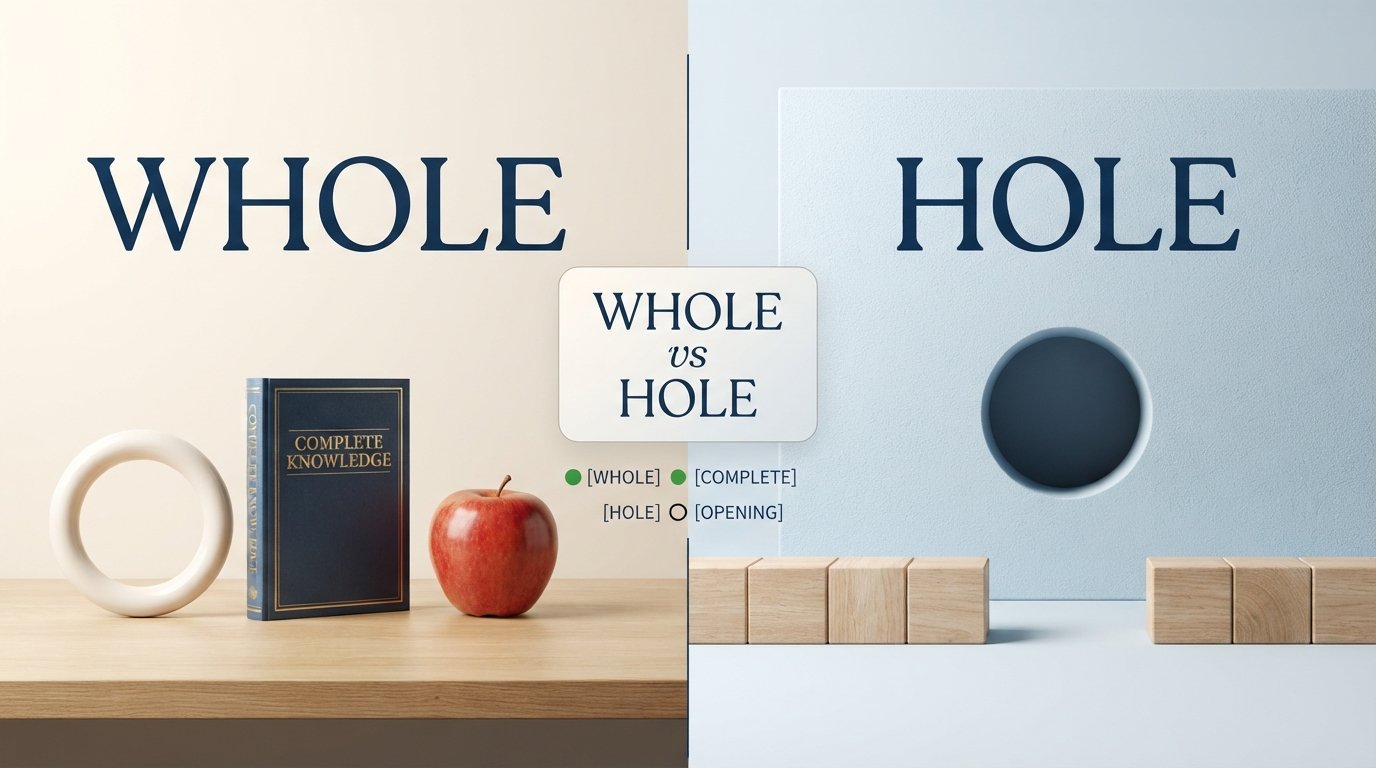
Ever written “whole” when you meant “hole”? These two words sound alike, but their meanings are completely different. Whole and hole are both correct English words, but they have different spellings, meanings, and uses.
Whole usually describes something that is complete, entire, or undivided, as in “She ate the whole cake.” Hole is a noun for an opening, hollow space, or empty area, as in “There is a hole in the wall.” The confusion comes from the fact that whole and hole are homophones—they have the same pronunciation but different spellings and meanings.
If you’re searching for whole or hole, you may be wondering which word belongs in your sentence and how to remember the difference. This guide explains their meanings, grammatical uses, common mistakes, and clear examples to help you choose the right word with confidence.
Whole or Hole
Use whole when you mean complete, entire, or all of something.
Use hole when you mean an opening, gap, or hollow space.
Quick Examples
- I ate the whole cake.
→ I ate all of the cake. - There is a hole in the cake box.
→ The box has an opening in it. - She read the whole book.
→ She read the entire book. - There is a hole in the wall.
→ The wall has an opening.
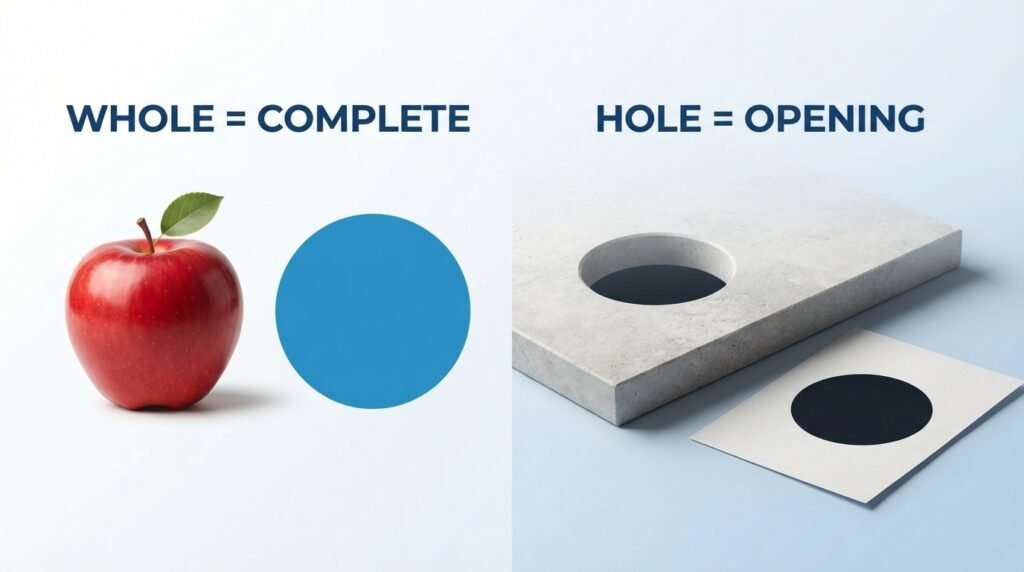
The Simple Rule
Whole = complete or entire
Hole = opening or gap
If you can replace the word with entire, choose whole.
If you can replace it with opening or gap, choose hole.
This is the easiest way to tell the difference between whole or hole.
The Origin of Whole or Hole
Although whole and hole sound the same today, they have different historical origins.
Where Does “Whole” Come From?
Whole developed from an Old English word related to the idea of being healthy, sound, complete, or unbroken.
Over time, its meaning became closely connected with the idea of something being complete or entire.
That meaning is still common today:
- the whole story
- the whole day
- the whole family
- the whole world
- the whole book
In each case, whole refers to something complete.
Where Does “Hole” Come From?
Hole comes from an Old English word meaning a hollow place, cavity, or opening.
Its basic meaning has remained clear over time.
Today, a hole can be:
- an opening in a wall
- a gap in a fence
- a hollow space in the ground
- a damaged opening in clothing
- an opening in a pipe
Why Do Whole and Hole Sound the Same?
The words have different origins and meanings, but their pronunciation became the same in modern English.
They are therefore homophones.
A homophone is a word that sounds the same as another word but has a different meaning or spelling.
Examples include:
- whole / hole
- right / write
- sea / see
- flower / flour
This is why hearing whole or hole is not enough to know which spelling someone means. The sentence and meaning provide the clue.
British English vs American English Spelling
There is no British-versus-American spelling difference between these two words.
Both British English and American English use:
- whole for complete or entire
- hole for an opening or hollow space
| Meaning | British English | American English |
|---|---|---|
| Complete or entire | whole | whole |
| Opening or gap | hole | hole |
| Entire book | whole book | whole book |
| Opening in a wall | hole in the wall | hole in the wall |
British English Examples
I read the whole book.
There is a hole in the wall.
American English Examples
I read the whole book.
There is a hole in the wall.
So, if you are asking “Is whole British and hole American?”, the answer is no.
The correct spelling depends on meaning, not on whether you are writing British or American English.
Which Spelling Should You Use?
The right spelling is based on what you want to say.
Use “Whole” for Complete Things
Use whole when you mean:
- complete
- entire
- all
- undivided
- the complete amount or group
Examples:
I watched the whole movie.
She spent the whole day studying.
He told me the whole story.
The whole family came to dinner.
I need the whole document.
In all of these examples, whole means the entire thing.
Use “Hole” for Openings
Use hole when you mean:
- an opening
- a gap
- a hollow space
- a cavity
- a space through or inside something
Examples:
There is a hole in my shirt.
The dog dug a hole in the garden.
We found a hole in the fence.
The ball went into the hole.
Water leaked through a hole in the roof.
Here, hole refers to an opening or hollow space.
A Fast Replacement Test
When you are unsure, replace the word in your sentence.
Example:
I read the ___ book.
Can you say:
I read the entire book.
Yes.
So the correct word is:
I read the whole book.
Now try:
There is a ___ in the wall.
Can you say:
There is an opening in the wall.
Yes.
So the correct word is:
There is a hole in the wall.
This quick test works well when you are unsure whether to use whole or hole.
Common Mistakes with Whole or Hole
Because these words sound the same, spelling mistakes are common.
Mistake 1: “Hole Movie”
❌ I watched the hole movie.
✅ I watched the whole movie.
The movie is complete or entire, so whole is correct.
Mistake 2: “Whole in the Wall”
❌ There is a whole in the wall.
✅ There is a hole in the wall.
The sentence refers to an opening, so hole is correct.
Mistake 3: “Hole Story”
❌ Tell me the hole story.
✅ Tell me the whole story.
The meaning is the complete story, so whole is correct.

Mistake 4: “Whole in My Shirt”
❌ There is a whole in my shirt.
✅ There is a hole in my shirt.
The shirt has an opening, so hole is correct.
Mistake 5: “Hole Family”
❌ My hole family came.
✅ My whole family came.
The meaning is the entire family, so whole is correct.
Quick Correction Table
| Incorrect | Correct | Reason |
|---|---|---|
| The hole movie | The whole movie | The entire movie |
| A whole in the wall | A hole in the wall | An opening |
| The hole story | The whole story | The complete story |
| A whole in my shirt | A hole in my shirt | An opening |
| My hole family | My whole family | The entire family |
| The whole in the fence | The hole in the fence | A gap or opening |
Whole or Hole in Everyday Examples
The easiest way to understand these words is to see how they work in normal writing.
Whole in Emails
Please read the whole email before replying.
Here, whole means the entire email.
Another example:
I need the whole report before the meeting.
The speaker wants the complete report.
Hole in Emails
Please check the hole in the package before accepting it.
Here, hole means an opening in the package.
Whole in News Writing
The whole community was affected by the storm.
Here, whole means the entire community.
The team spent the whole day searching for the missing item.
Again, it means the complete amount of time.
Hole in News Writing
Workers found a large hole in the road.
Here, hole refers to an opening or damaged area.
The storm created a hole in the roof.
The word describes a physical opening.
Whole on Social Media
I watched the whole video!
This means the person watched it from beginning to end.
That was the whole point!
Here, whole refers to the complete idea or reason.
Hole on Social Media
There is a hole in my favorite shirt. 😭
The word describes an opening in the shirt.
I almost fell into a hole!
Here, hole means an opening in the ground.
Whole in Formal Writing
The whole process may take several hours.
Here, whole means the entire process.
Hole in Formal Writing
The inspection revealed a hole in the outer wall.
Here, hole means an opening or damaged space.
Bicep or Biceps: Formal Term or Common Usage?
Whole or Hole – Search Interest and Usage Context
People search for whole or hole mainly because the two words sound the same but have different meanings and spellings.
The words themselves are both common, but they appear in different language contexts.
Common Uses of “Whole”
You will often see whole with words related to:
- time
- people
- stories
- books
- movies
- groups
- food
- objects
- ideas
Common phrases include:
- whole day
- whole week
- whole family
- whole world
- whole story
- whole book
- whole movie
- whole number
- whole process
Common Uses of “Hole”
You will often see hole with words related to:
- walls
- roads
- clothing
- pipes
- gardens
- ground
- fences
- construction
- golf
Common phrases include:
- hole in the wall
- hole in the ground
- hole in a shirt
- hole in the road
- hole in a pipe
- hole in the fence
- golf hole
- rabbit hole
Why Do People Search for “Whole or Hole”?
The main confusion comes from pronunciation.
When someone hears:
“I read the whole book.”
they may know the meaning but still be unsure how to spell whole.
Likewise, when someone hears:
“There is a hole in the wall.”
they may know that the speaker means an opening but still wonder whether the spelling is hole or whole.
That is why searches such as whole or hole, hole or whole, whole vs hole, and whole and hole difference are useful learning queries.
The important point is that neither word is a British-only or American-only form. The meaning tells you which spelling to use.
Whole vs Hole – Side-by-Side Comparison
| Feature | Whole | Hole |
|---|---|---|
| Meaning | Complete or entire | Opening, gap, or hollow space |
| Pronunciation | Same as “hole” | Same as “whole” |
| Spelling | W-H-O-L-E | H-O-L-E |
| Main idea | Completeness | Opening |
| Common use | Whole story | Hole in the wall |
| Example | I read the whole book. | There is a hole in the wall. |
| British English | Whole | Hole |
| American English | Whole | Hole |
| Easy replacement | Entire | Opening or gap |
Common Phrase Comparison
| With “Whole” | With “Hole” |
|---|---|
| whole story | hole in the wall |
| whole day | hole in the ground |
| whole family | hole in a shirt |
| whole book | hole in the road |
| whole movie | hole in the fence |
| whole process | hole in a pipe |
| whole world | golf hole |
This table makes the difference easy to see: whole usually describes completeness, while hole names an opening or hollow space.
Easy Ways to Remember Whole or Hole
If you often confuse these words, use one of these simple memory tricks.
Remember: Whole = Complete
Think of the phrase:
the whole thing
It means the complete thing.
Examples:
- the whole book
- the whole story
- the whole day
- the whole family
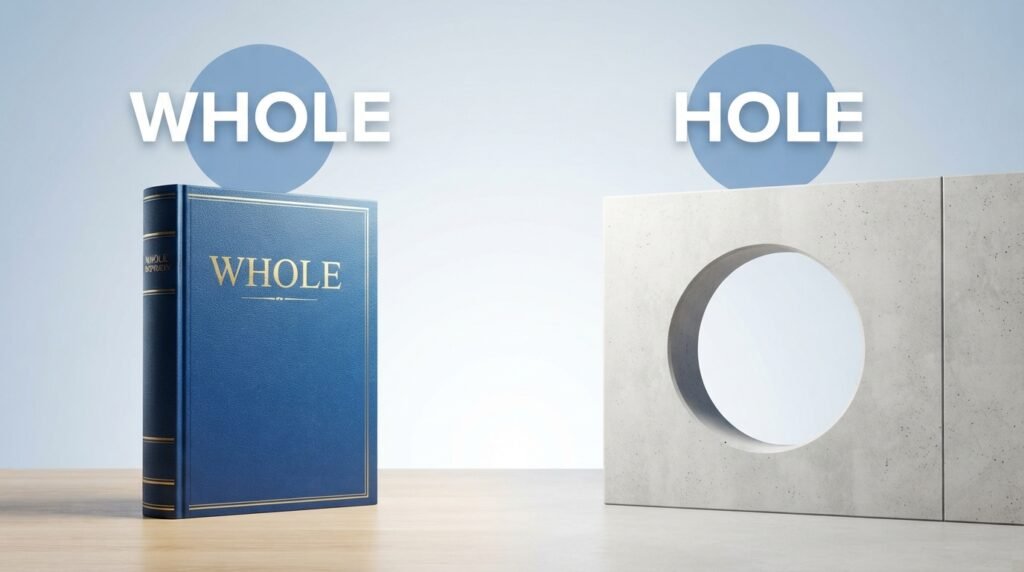
Remember: Hole = Opening
Think of a physical opening:
a hole in the wall
Other examples:
- hole in a shirt
- hole in the ground
- hole in the fence
- hole in the roof
Use the “Entire” Test
If entire works in the sentence, use whole.
I watched the entire movie.
Therefore:
I watched the whole movie.
Use the “Opening” Test
If opening or gap works, use hole.
There is an opening in the wall.
Therefore:
There is a hole in the wall.
These two tests are usually enough to solve the whole or hole spelling problem quickly.
Simular or Similar: Similar Is the Correct Spelling
FAQs About Whole or Hole
1. Which is correct, whole or hole?
Both whole and hole are correct words. Use whole when you mean complete or entire. Use hole when you mean an opening, gap, or hollow space.
2. What is the difference between whole and hole?
Whole means complete or entire.
Hole means an opening, gap, or hollow space.
For example:
I ate the whole apple.
There is a hole in the apple.
3. Are whole and hole pronounced the same?
Yes. Whole and hole are homophones in standard English. They sound the same but have different meanings and spellings.
4. Is whole British or American English?
Whole is used in both British and American English. It is not limited to one variety of English.
5. Is hole British or American English?
Hole is also used in both British and American English. Its spelling does not change between these varieties.
6. How do you spell whole?
The correct spelling is whole: W-H-O-L-E.
Use it when you mean complete or entire.
Example:
I read the whole book.
7. How do you spell hole?
The correct spelling is hole: H-O-L-E.
Use it when you mean an opening or hollow space.
Example:
There is a hole in the wall.
8. Can whole and hole be used in the same sentence?
Yes.
The whole wall has a large hole in it.
Here, whole means the entire wall, while hole means an opening.
9. What does whole mean?
Whole means complete, entire, or all of something.
Example:
She ate the whole cake.
This means she ate all of the cake.
10. What does hole mean?
Hole means an opening, gap, or hollow space in something.
Example:
There is a hole in the fence.
This means the fence has an opening.
Conclusion
The difference between whole or hole is simple once you focus on meaning. Whole means complete, entire, or all of something. Hole means an opening, gap, or hollow space. The two words sound the same, which is why they are easy to confuse in writing.
Use whole in phrases such as the whole story, the whole day, the whole family, the whole book, and the whole process. Use hole in phrases such as a hole in the wall, a hole in the ground, a hole in a shirt, and a hole in the fence.
There is no British-versus-American spelling difference between them. Both varieties use whole and hole in the same way. The key is the meaning of the sentence.
When you are unsure, use the simple replacement test. If you can replace the word with entire, choose whole. If you can replace it with opening or gap, choose hole.
Once you remember whole = complete and hole = opening, this common homophone mistake becomes much easier to avoid.

I’m a U.S. based content writer and language researcher with a strong focus on English grammar, spelling differences, and frequently confused terms. My writing is aimed at helping readers write more clearly and correctly in daily use, workplace communication, and digital content.