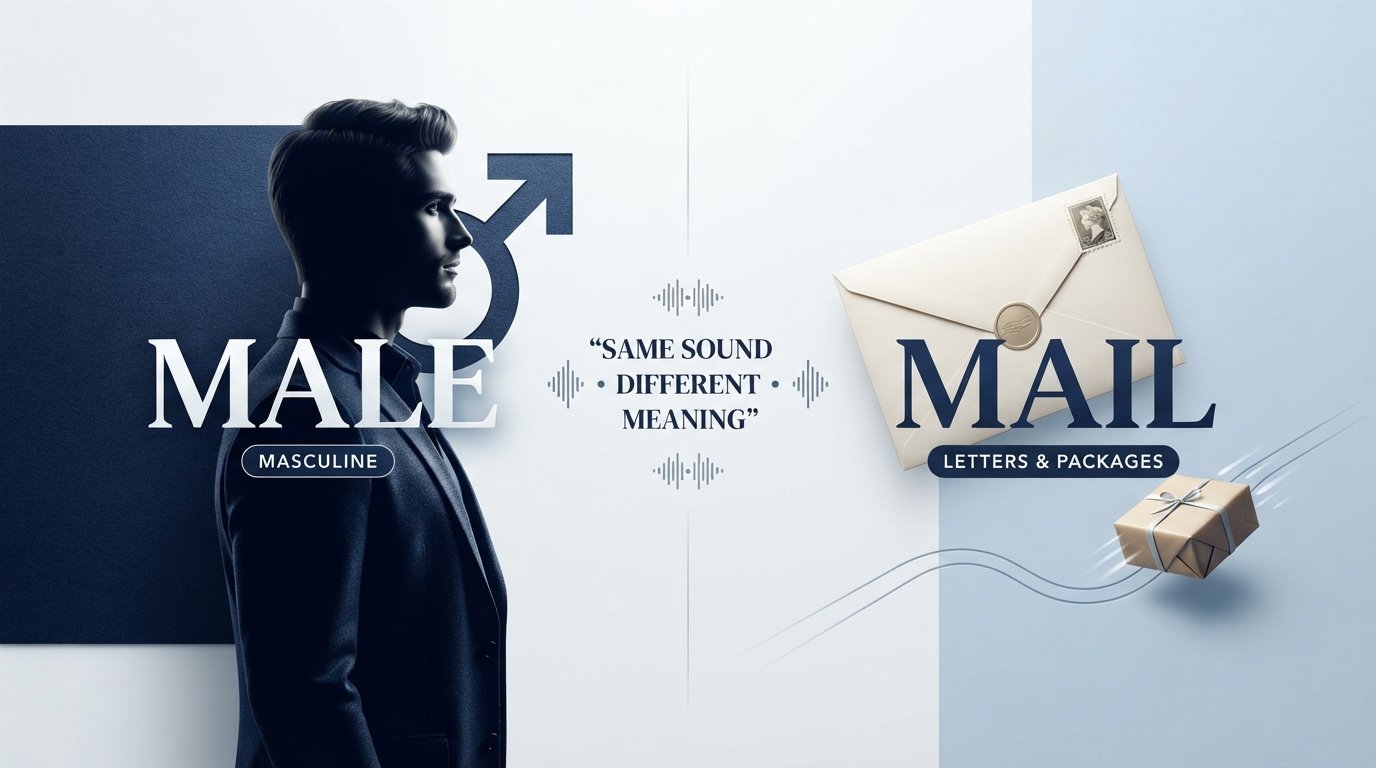
Have you ever heard the word male and wondered if it should be spelled mail? These two words are easy to confuse because they have the same pronunciation but completely different meanings. A single letter can change the meaning of a sentence.
Male refers to the masculine sex. It can describe a person, animal, plant, or organism. Mail refers to letters, parcels, and other items sent through a postal system. It can also be used as a verb when you send something by post.
People often search for male or mail, mail or male, and male vs mail because these words are homophones. When you hear them in conversation, the sound alone does not tell you which spelling is correct. You need to use the meaning and context of the sentence.
The good news is that the difference is simple once you connect each word with its meaning. In this guide, you will learn when to use male or mail, how the words developed, whether British and American English spell them differently, common mistakes, everyday examples, and an easy way to remember the correct spelling.
Male or Mail
Male and mail are both correct words, but they are used in completely different situations.
Male = masculine sex
Use male when you are talking about a person, animal, plant, or organism of the male sex.
Examples:
- The male lion has a large mane.
- He is a male student.
- We saw a male bird in the garden.
- The study included both male and female participants.
Male can work as an adjective or a noun.
Mail = letters, parcels, or postal service
Use mail when you are talking about letters, documents, packages, or other items sent through the postal system.
Examples:
- I received the mail this morning.
- There is a letter in the mail.
- The package arrived by mail.
- Please mail the form today.
Mail can work as both a noun and a verb.

The simple rule
Male = masculine
Mail = letters, packages, or sending something
For example:
The male dog is sleeping outside.
I received the mail today.
Both words sound the same, but the meaning of the sentence tells you which spelling to use.
The Origin of Male or Mail
Although male and mail sound the same today, they have different histories.
Where does “male” come from?
Male entered English through Old French masle and can be traced back to Latin masculus, meaning “male” or “masculine.”
Over time, the word became the standard English term for the male sex. Today, it is used for people, animals, plants, and other organisms when the male sex is relevant.
For example:
- male student
- male actor
- male lion
- male bird
- male plant
The word can also be used as a noun:
The male of the species is larger than the female.
Where does “mail” come from?
The postal word mail has a very different history. It developed from an older word referring to a bag, wallet, or traveling sack. Such bags were used to carry letters and other items.
Over time, the meaning changed from the container to the letters and parcels carried inside it. Eventually, mail came to refer to postal items and the system used to transport them.
It later became a verb:
Please mail the documents tomorrow.
So, although male and mail now sound alike, their histories are separate.
Why are they spelled differently?
English contains many homophones. These are words that have the same pronunciation but different meanings and spellings.
The different spellings of male and mail are mainly the result of their separate historical origins. The spelling difference helps readers understand which word is meant when the words appear in writing.
British English vs American English Spelling
There is no spelling difference between British and American English for male and mail.
| Word | British English | American English | Meaning |
|---|---|---|---|
| Male | male | male | Masculine sex |
| Letters, parcels, or postal items | |||
| Mailed | mailed | mailed | Sent by post |
| Mailing | mailing | mailing | Sending through the postal system |
So, whether you are writing for a British or American audience, the spelling remains the same.
The regional difference is “mail” vs “post”
The bigger difference is not the spelling of mail. It is the word people commonly use for postal services.
American English commonly uses mail:
I need to send this letter by mail.
British English often uses post:
I need to send this letter by post.
However, mail is still found in British names and established expressions, so the distinction is not absolute.
The important rule is simple:
Male does not become mail in British English, and mail does not become male in American English.
The spelling depends on the meaning, not the country.
Which Spelling Should You Use?
Choosing between male and mail is easy when you identify what the sentence is about.
Use “male” for sex
Choose male when the sentence describes the male sex.
Examples:
- a male student
- a male teacher
- a male athlete
- a male lion
- a male dog
- a male bird
- a male plant
For example:
The male elephant stayed close to the group.
Here, male describes the sex of the elephant.
Use “mail” for postal items
Choose mail when you mean letters, parcels, documents, or other items delivered through a postal system.
Examples:
- receive mail
- send mail
- check the mail
- open the mail
- sort the mail
- mail a letter
- mail a package
For example:
I checked the mail after lunch.
Here, mail refers to postal items.
Use “mail” as a verb
One useful difference is that mail can also be a verb.
I will mail the application tomorrow.
She mailed the invitation last week.
We are mailing the documents today.
You cannot replace mail with male in these sentences.
Incorrect:
I will male the application tomorrow.
Correct:
I will mail the application tomorrow.
Write or Right: Two Words, Two Completely Different Meanings
Common Mistakes with Male or Mail
Because the two words sound the same, spelling mistakes usually happen when someone writes from memory or relies only on pronunciation.
Mistake 1: Using “male” for postal mail
Incorrect:
I received a male this morning.
Correct:
I received some mail this morning.
If you mean letters, documents, or packages, use mail.
Mistake 2: Using “mail” for a male person
Incorrect:
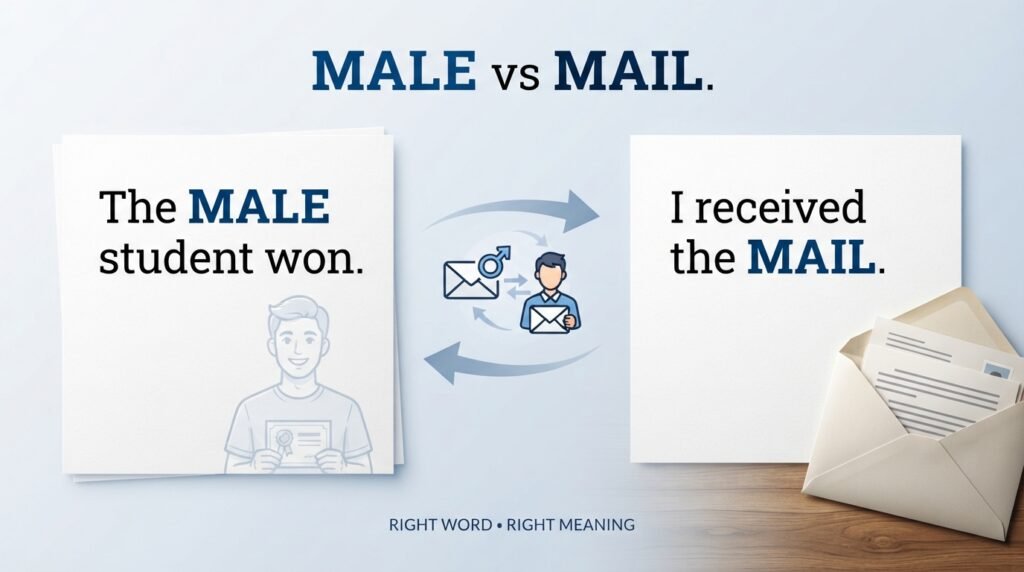
The mail student won the race.
Correct:
The male student won the race.
The student is being described as male, so male is correct.
Mistake 3: Writing “male” as a verb
Incorrect:
Please male the documents today.
Correct:
Please mail the documents today.
Only mail works as the verb meaning “send by post.”
Mistake 4: Confusing them in forms
Consider this sentence:
The form asks whether the applicant is male or female.
Here, male is correct because the form is asking about sex.
But:
Please return the completed form by mail.
Here, mail is correct because the sentence refers to sending the form.
Mistake 5: Choosing by sound
If you hear:
“mail”
you cannot know the spelling from pronunciation alone.
Instead, ask:
What does the word mean in this sentence?
If it means masculine, choose male.
If it means letters, parcels, or sending something, choose mail.
Male or Mail in Everyday Examples
Seeing the words in different situations makes the difference easier to remember.
In emails
Male:
The survey included male and female participants.
Mail:
I will mail the signed form tomorrow.
In professional writing
Male:
The company hired a male assistant for the position.
Mail:
Please mail the completed application to the office.
In news writing
Male:
A male suspect was seen near the building.
Mail:
The documents were sent through the mail.
In social media
Male:
The movie has a strong male lead.
Mail:
My package finally arrived in the mail.
In everyday conversation
Male:
Is that a male or female bird?
Mail:
Did you check the mail?
As a verb
Mail is also used when someone sends something:
I need to mail this letter.
She mailed the package yesterday.
They are mailing the invitations this week.
Male vs Mail – Comparison Table
| Feature | Male | |
|---|---|---|
| Basic meaning | Related to the masculine sex | Letters, parcels, or postal communication |
| Common use | People, animals, plants, and some technical terms | Postal items and sending items |
| Part of speech | Noun and adjective | Noun and verb |
| Pronunciation | /meɪl/ | /meɪl/ |
| Sound | Same as “mail” | Same as “male” |
| Spelling | M-A-L-E | M-A-I-L |
| Example | The male lion is strong. | I received the mail. |
| Verb use | Not normally used as a verb | Mail, mailed, mailing |
| Related idea | Masculine sex | Post, letters, parcels |
Male and Mail – Related Words and Forms
The following words are connected to male or mail in different ways.
| Word | Type | Meaning | Example |
|---|---|---|---|
| Male | Noun/adjective | Masculine sex | The male bird flew away. |
| Males | Plural noun | More than one male | Three males were present. |
| Noun/verb | Postal items or sending them | I received the mail. | |
| Mailed | Verb | Sent by post | She mailed the package. |
| Mailing | Verb/noun | Sending by post | We are mailing the forms. |
| Mailbox | Compound noun | A box for receiving mail | The letter is in the mailbox. |
| Compound noun/verb | Electronic mail or sending it | I sent an email. | |
| Airmail | Compound noun | Mail transported by air | The letter was sent by airmail. |
Notice that mailbox, email, and airmail are related to the postal meaning of mail, not to male.
Whole or Hole: Same Sound, Different Meanings
Male or Mail – Search Intent and Usage Patterns
People search for male or mail in several different ways. Some want a quick spelling answer, while others want to understand the difference between the two words.
Common searches include:
- male or mail
- mail or male
- male vs mail
- mail vs male
- male and mail difference
- difference between male and mail
- is it male or mail?
- how do you spell mail?
- how do you spell male?
- male meaning
- mail meaning
- male pronunciation
- mail pronunciation
- male or mail in a sentence
The confusion is especially common for English learners because pronunciation does not reveal the spelling. A learner may hear male and write mail, or hear mail and write male.
Regional English also affects how people talk about postal services. Mail is common in American English, while post is often preferred in British English. However, this regional difference does not change the spelling of male.
For digital communication, mail also appears in words such as email, which is now widely used in English.
The safest way to choose the spelling is to focus on the meaning of the sentence rather than the sound.
An Easy Way to Remember Male vs Mail
Use this simple memory trick:
Male = masculine
Think of:
male → man → masculine
If the sentence is about the male sex, use male.
The male dog is sleeping.
Mail = messages and packages
Think of:
mail → letters → packages
If the sentence is about postal communication, use mail.
The mail arrived this morning.
One question can solve the confusion
Before writing the word, ask:
Am I talking about sex, or am I talking about something being sent?
Sex → male
Letters/packages → mail
This works even when both words sound exactly the same.
Male or Mail – Practice Questions
Choose male or mail in each sentence.
- The ___ lion was resting under a tree.
- Did you receive the ___ today?
- Please ___ the documents before Friday.
- The ___ student answered the question.
- I sent the package by ___.
- The zoo has two ___ gorillas.
- There was a letter in the ___.
- The study included both ___ and female participants.
Answers
- male
- male
- male
- male
If you can identify what the word means in each sentence, choosing the correct spelling becomes much easier.
FAQs About Male or Mail
Is it male or mail?
Both words are correct, but they have different meanings. Male refers to the masculine sex, while mail refers to letters, parcels, postal communication, or the act of sending something by post.
Are male and mail homophones?
Yes. Male and mail are homophones because they have the same pronunciation but different spellings and meanings.
What does male mean?
Male describes a person, animal, plant, or organism of the male sex. It can be used as both a noun and an adjective.
What does mail mean?
Mail refers to letters, parcels, documents, and other items sent through a postal system. It can also be a verb meaning to send something by post.
Do male and mail sound the same?
Yes. In standard English pronunciation, both are commonly pronounced /meɪl/. Their spelling and meaning are different even though their pronunciation is the same.
Is “I received a male” correct?
Not if you mean a letter, parcel, or other postal item. The correct sentence is:
I received some mail.
If you mean a male person or animal, the word male may be correct, but the sentence would need appropriate context.
Is “I will male the letter” correct?
No. The correct sentence is:
I will mail the letter.
Mail is the verb used for sending something through the postal system.
Is mail British or American English?
Mail is used in both British and American English. However, post is often more common in everyday British English when referring to postal services. American English commonly uses mail.
Conclusion
The difference between male or mail is simple once you connect each word with its meaning. Male refers to the masculine sex and can describe people, animals, plants, and other organisms. Mail refers to letters, parcels, documents, and postal communication. It can also be used as a verb when you send something by post.
The two words are homophones, so they sound the same but are spelled differently. This is why they are easy to confuse when you hear them in conversation. The spelling cannot be chosen from pronunciation alone. You need to look at the meaning and context.
Remember the easiest rule: male = masculine, while mail = letters, packages, or sending something.
For example, “The male dog is outside” describes the dog’s sex, while “The mail is outside” refers to postal items. In British English, you may also hear post for postal services, while mail is especially common in American English. However, male and mail themselves keep the same spelling in both varieties.
Once you remember this simple difference, you can use both words correctly in emails, applications, schoolwork, professional writing, and everyday conversation.
Male describes sex. Mail carries letters and packages.

I’m a U.S. based content writer and language researcher with a strong focus on English grammar, spelling differences, and frequently confused terms. My writing is aimed at helping readers write more clearly and correctly in daily use, workplace communication, and digital content.