Write or right? These two words sound the same, but they do not mean the same thing. That is why even confident English speakers can mix them up when writing quickly.
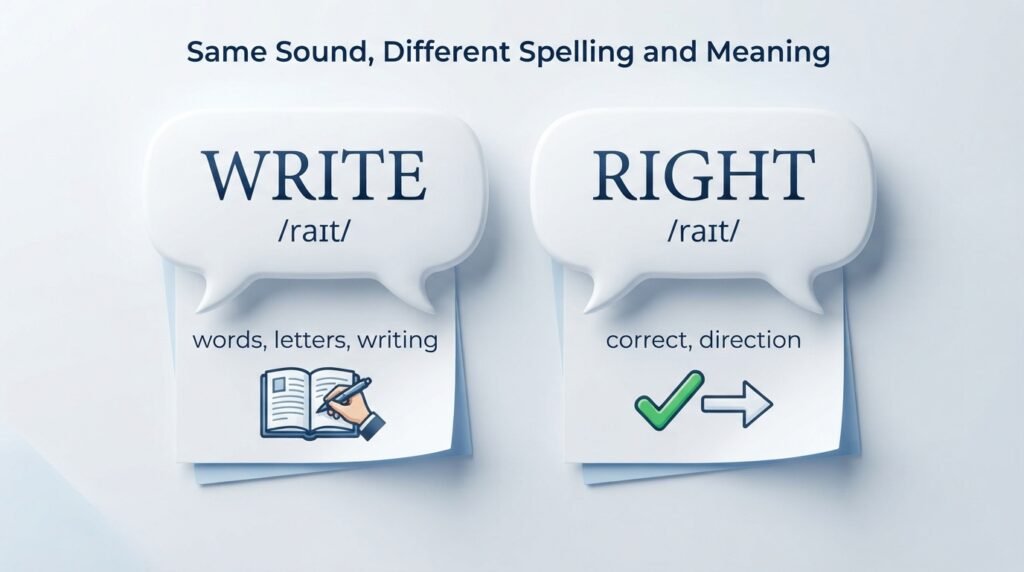
The easiest way to understand the difference is simple: write is about putting words, letters, numbers, or ideas into written form, while right can mean correct, proper, or the direction opposite to left. The two words are pronounced the same, but their spellings and meanings are different.
People often search for “write or right,” “write vs right,” “right or write,” and “difference between write and right” because the words are easy to confuse in emails, schoolwork, social media posts, forms, and everyday messages.
This guide gives you the answer first, then explains the meaning, pronunciation, history, grammar, common mistakes, and real-life usage of both words. You will also see simple sentence examples and an easy memory trick.
By the end, you will know exactly when to use write and when to use right.
Write or Right
Write and right are different words with different meanings, even though they sound the same.
Use write when you mean:
- put words on paper or a screen
- record information
- create a letter, article, story, or message
- form letters, words, or numbers
Examples:
- Please write your name here.
- I need to write an email.
- She likes to write stories.
- Can you write this number down?
Use right when you mean:
- correct
- proper or suitable
- the opposite direction of left
- a legal or moral entitlement
Examples:
- Your answer is right.
- Is this the right address?
- Turn right at the next street.
- Everyone has the right to speak.
The easiest rule
Write = put words into writing.
Right = correct, proper, or opposite of left.
So:
Please write your answer.
But:
Your answer is right.
Write vs Right Pronunciation
One major reason these words cause confusion is their pronunciation.
Write and right are pronounced the same way:
/raɪt/
They sound like the word light without the l sound.
Because they sound alike but have different meanings and spellings, write and right are called homophones.
This means you usually cannot choose the correct word just by listening. You need to understand the sentence.
For example:
I want to write a letter.
and:
You are right.
The words sound the same, but their meanings are completely different.
A useful listening trick
When you hear /raɪt/, ask yourself:
Is the sentence about writing?
If yes, choose write.
Is it about being correct, direction, or a right someone has?
If yes, choose right.
The Origin of Write or Right
Although write and right now sound alike, they developed from different historical roots.
Origin of Write
The word write has very old Germanic roots. Its early history was connected with making marks, scratching, or forming signs on a surface.
Over time, its meaning developed into the familiar modern idea of putting letters, words, and ideas into written form.
Today, write can describe many forms of communication:
- writing by hand
- typing on a computer
- sending a written message
- creating a story
- writing an article
- recording information
For example:
She wants to write a book.
The past forms are also important:
- write – present
- wrote – past
- written – past participle
- writing – -ing form
Example:
I write every day.
I wrote a letter yesterday.
I have written three pages.
Origin of Right
The word right also has very old Germanic roots. Its early meanings were linked with ideas such as straight, proper, correct, and just.
The word later developed several meanings that are still common today.
For example:
Correct:
That is the right answer.
Direction:
Turn right at the corner.
Entitlement:
Everyone has the right to speak.
This is why right can appear in many different types of sentences.
The two words eventually came to have the same pronunciation, but their meanings and spellings remained different.
British English vs American English Spelling
There is no British-versus-American spelling difference between write and right.
British English uses:
- write
- right
American English also uses:
- write
- right
The difference is therefore not about choosing a British spelling or an American spelling.
It is about choosing the word that matches your meaning.
| Word | British English | American English | Meaning |
|---|---|---|---|
| Write | write | write | Put words or information into written form |
| Right | right | right | Correct, proper, or opposite of left |
| Wrote | wrote | wrote | Past tense of write |
| Written | written | written | Past participle of write |
| Writing | writing | writing | Present participle of write |
For example, both British and American writers use:
Please write your name.
And:
You are right.
So, if you are wondering whether write is British and right is American, the answer is no.
They are separate English words, not two regional spellings of one word.
Which Word Should You Use: Write or Right?
Do not choose between write and right based on your country.
Choose the word based on its meaning.
Use “write” for written communication
Use write when someone is putting words, letters, numbers, or ideas into written form.
Examples:
Write your name on the form.
I will write to you tomorrow.
She wants to write an article.
He writes for a local newspaper.
Please write down the address.
Use “right” for correctness
Use right when something is correct or true.
Examples:
You are right.
That is the right answer.
I think we made the right choice.
Is this the right information?
Use “right” for direction
Use right when you mean the opposite of left.
Examples:
Turn right after the bank.
Look to your right.
The store is on the right.
Use “right” for an entitlement
Right can also mean something a person is entitled to have or do.
Examples:
Everyone has the right to learn.
You have the right to ask questions.
People have certain legal rights.
The key point
There is no situation where you should use right simply because you are writing in American English, or write because you are writing in British English.
The meaning decides the word.
Write or Right: The 5-Second Rule
If you forget which one to use, try this quick test.
Question 1:
Can I replace the word with “put into written form”?
If yes, use write.
Please write your name.
→ Please put your name into written form.
Question 2:
Can I replace the word with “correct”?
If yes, use right.
Your answer is right.
→ Your answer is correct.
Question 3:
Am I talking about the opposite of left?
If yes, use right.
Turn right.
Question 4:
Am I talking about an entitlement or freedom?
If yes, use right.
You have the right to choose.
This simple test can solve most write or right mistakes in seconds.
Common Mistakes with Write or Right
These mistakes usually happen because the words sound identical.
Mistake 1: Right your name
❌ Please right your name.
✅ Please write your name.
You are asking someone to put their name into written form, so write is correct.
Mistake 2: Your answer is write
❌ Your answer is write.
✅ Your answer is right.
Here, right means correct.
Mistake 3: Turn write
❌ Turn write at the next street.
✅ Turn right at the next street.
Here, right means the opposite direction from left.

Mistake 4: I will right an email
❌ I will right an email.
✅ I will write an email.
An email is something you compose in written form, so use write.
Mistake 5: Is this the write answer?
❌ Is this the write answer?
✅ Is this the right answer?
The meaning is “correct,” so right is correct.
Mistake 6: You have the write to choose
❌ You have the write to choose.
✅ You have the right to choose.
Here, right means an entitlement.
Whole or Hole: Same Sound, Different Meanings
Write or Right in Everyday Examples
Knowing the difference is easier when you see both words in normal situations.
In Emails
Use write when talking about creating or sending written communication.
I will write an email this afternoon.
Please write back when you can.
Could you write down the details?
Use right when talking about correctness.
Is this the right email address?
You are right about the date.
In School and College
Write is common when students create answers or assignments.
Write your answer in complete sentences.
Students must write a short essay.
Right is used when an answer is correct.
Choose the right answer.
You got the answer right.
In News and Articles
Writers often use write when discussing journalism or content creation.
The reporter will write a story about the event.
Right can describe correctness or direction.
The driver turned right at the intersection.
The information was right.
On Social Media
Both words can appear in casual online writing.
I need to write a caption.
You were right about that.
I will write a post later.
Right now, I am busy.
Here, right now means at this exact time.
In Formal Writing
Both words are common in professional and academic English.
Please write your full name below.
Select the right option.
The researcher wrote a detailed report.
The final answer was right.
The important thing is to choose the word based on its meaning.
Write vs Right: Grammar and Word Forms
Understanding the grammar of each word can make the difference even clearer.
Write is mainly a verb
It describes an action.
| Form | Example |
|---|---|
| Write | I write every day. |
| Writes | She writes every day. |
| Wrote | He wrote a letter. |
| Written | She has written a report. |
| Writing | I am writing an article. |
Remember:
write → wrote → written
Not:
write → right → written
Right is a completely different word.
Right has several grammatical uses
Right can work as an adjective:
That is the right answer.
As an adverb:
You guessed right.
As a noun:
Everyone has rights.
It can also describe direction:
Turn right.
This is one reason right appears in many more sentence patterns than write.
Write or Right – Comparison Table
| Feature | Write | Right |
|---|---|---|
| Pronunciation | /raɪt/ | /raɪt/ |
| Main use | Writing or recording words | Correctness, direction, suitability, or entitlement |
| Main part of speech | Verb | Adjective, adverb, noun, and more |
| Meaning “correct” | No | Yes |
| Meaning “opposite of left” | No | Yes |
| Used for writing | Yes | No |
| Past tense | Wrote | Righted, when used as a verb |
| Past participle | Written | Righted, when used as a verb |
| Example | I write emails. | That is the right answer. |
| Direction | No | Turn right. |
| Entitlement | No | You have a right to choose. |
The simplest comparison
Write = an action involving written words.
Right = correct, proper, direction, or entitlement.
Write or Right: Similar Words You Should Know
There are a few other English words that can sound like write and right, so they can cause even more confusion.
Rite
Rite usually means a formal ceremony or ritual.
The ceremony included an ancient rite.
Wright
Wright is a much less common word. It traditionally refers to a person who makes or builds something, and it still appears in words such as playwright.
She is a successful playwright.
These words are not interchangeable.
For everyday writing, the most important distinction remains:
write = put words into written form
right = correct or opposite of left
Write or Right – Google Trends & Usage Data
Search interest for write or right can change over time and across locations.
People may search this phrase for different reasons, including:
- checking a spelling mistake
- learning English
- completing schoolwork
- checking an email
- understanding homophones
- improving grammar
- finding the correct word for a sentence
Searches can also appear in different forms, such as:
- write or right
- right or write
- write vs right
- difference between write and right
- how do you spell write
- how do you spell right
- write and right difference
Write or Right in Different Contexts
| Context | Correct Word | Example |
|---|---|---|
| Put your name on a form | Write | Write your name here. |
| Correct answer | Right | That is the right answer. |
| Create an email | Write | I will write an email. |
| Direction opposite left | Right | Turn right here. |
| Create a story | Write | She will write a story. |
| Correct decision | Right | We made the right decision. |
| Record information | Write | Write the number down. |
| Entitlement | Right | You have the right to choose. |
| Create an article | Write | He will write an article. |
| Correct information | Right | Is this information right? |
Frequently Asked Questions About Write or Right
1. What is the difference between write and right?
Write means to put words, letters, numbers, or ideas into written form. Right can mean correct, proper, the opposite of left, or an entitlement.
2. Is it write or right?
Both spellings are correct, but they have different meanings. Use write for writing and right for correctness, direction, suitability, or entitlement.
3. Are write and right pronounced the same?
Yes. In standard English, write and right are pronounced the same: /raɪt/.
4. Are write and right homophones?
Yes. They are homophones because they have the same pronunciation but different spellings and meanings.
5. How do you spell write?
Use write when you mean the action of putting words, letters, numbers, or ideas into written form.
Example:
Please write your name.
6. How do you spell right?
Use right when you mean correct, proper, the opposite of left, or an entitlement.
Example:
You chose the right answer.
7. Is write British or American English?
Write is used in both British and American English. It is not a British-only spelling.
8. Is right British or American English?
Right is also used in both British and American English. It is not an American-only spelling.
9. What is the past tense of write?
The past tense of write is wrote.
She wrote a letter yesterday.
The past participle is written.
She has written a letter.
10. Why are write and right confusing?
They are confusing because they sound the same but have different spellings and meanings. The sentence context tells you which word to use.
Final Difference Between Write and Right
The difference between write and right is simple once you connect each word with its main meaning.
Use write when you are talking about putting words, letters, numbers, or ideas into written form:
Write your name here.
Use right when you mean correct:
Your answer is right.
Use right when you mean the opposite direction from left:
Turn right at the corner.
Use right when you mean an entitlement:
Everyone has the right to speak.
The two words sound the same, so pronunciation cannot tell you which spelling to choose. Instead, look at the meaning of the sentence.
A useful memory rule is:
Write = words.
Right = correct, direction, or entitlement.
There is also no British-versus-American spelling difference between these words. English speakers in both varieties use write and right.
Once you remember what each word means, choosing between write or right becomes much easier. When the sentence is about creating written words, choose write. When it is about being correct, turning in a direction, or having an entitlement, choose right.