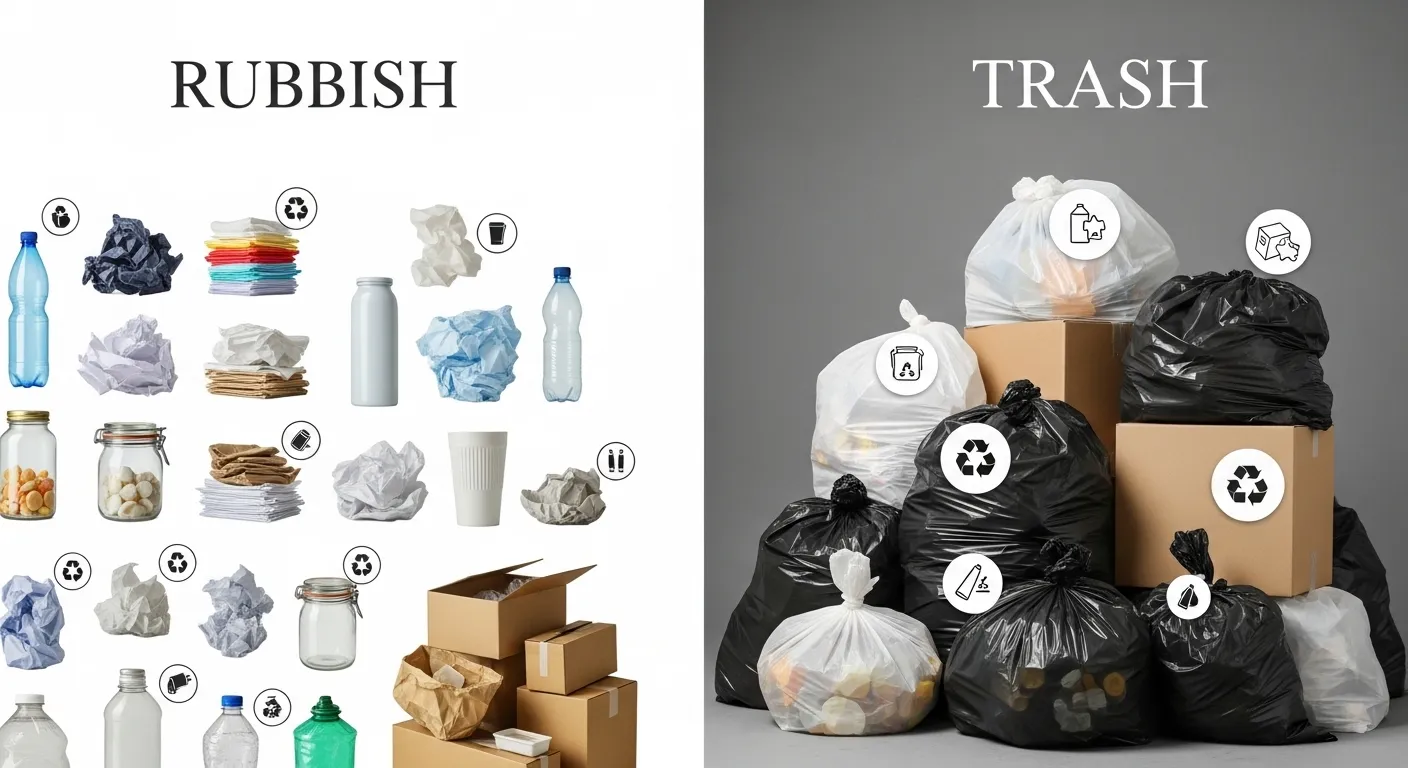
Wondering whether to say rubbish or trash? You are not alone. Both words mean waste or things you throw away, but the right choice depends on where you are writing.
In British English, rubbish is the standard word. In American English, trash is far more common. That simple regional difference causes a lot of confusion for writers, students, and English learners.
In this guide, you will learn the difference between rubbish and trash, where each word comes from, and when to use each one with confidence.
Rubbish or Trash – Quick Answer
Both rubbish and trash are correct words. They mean unwanted waste or things that should be thrown away.
- Rubbish is used mainly in British English.
- Trash is used mainly in American English.
Examples
- British English: Please take the rubbish out.
- American English: Please take the trash out.
Both sentences mean the same thing. Only the regional preference changes.
The Origin of Rubbish andTrash
Origin of Rubbish
The word rubbish comes from the Middle English word rubbes, meaning broken stones or debris from building work. Over time, its meaning expanded to include any useless or unwanted material.
Later, it also gained a second meaning. In British English, rubbish can describe something foolish or untrue.
- That idea is rubbish.
- What he said was complete rubbish.
Origin of Trash
The word trash comes from an older Scandinavian source, likely related to words meaning fallen leaves, twigs, or waste. It entered English in the 16th century.
It first referred to worthless material. Over time, it became the standard American term for garbage.
It can also describe something of poor quality.
- The movie was trash.
- That magazine publishes trash.
British English vs American English Spelling
The difference between rubbish and trash is not about spelling. It is about regional vocabulary.
British English prefers rubbish. American English prefers trash.
| British English | American English | Meaning |
| Rubbish | Trash | Waste material |
| Rubbish bin | Trash can | Container for waste |
| Rubbish collection | Trash pickup | Waste removal service |
| Rubbish bag | Trash bag | Plastic waste bag |
Example Sentences
- UK: The rubbish bin is full.
- US: The trash can is full.
- UK: Rubbish collection is every Tuesday.
- US: Trash pickup is every Tuesday.
Which Spelling Should You Use?
Choose the word based on your audience.
Use Trash If:
- You are writing for an American audience.
- Your readers are in the United States.
- You are using American English style guides.
Use Rubbish If:
- You are writing for a British audience.
- Your readers are in the UK, Australia, New Zealand, or other Commonwealth countries.
- You are following British English conventions.
For Global Audiences
Either word can work. However, choose one style and stay consistent throughout your writing.
If your audience is mixed, consider the region you want to prioritize.
Common Mistakes with Trash or Rubbish
Writers often confuse these terms or mix regional styles.
Mistake 1: Mixing UK and US Terms
❌ Please put the rubbish in the trash can.
✅ UK: Please put the rubbish in the rubbish bin.
✅ US: Please put the trash in the trash can.
Mistake 2: Using the Wrong Regional Style
❌ American business email: The rubbish will be collected tomorrow.
✅ American business email: The trash will be collected tomorrow.
Mistake 3: Inconsistent Usage
Choose one form and use it throughout your document.
❌ The trash is outside. Rubbish collection starts at noon.
✅ The trash is outside. Trash collection starts at noon.
Trash and Rubbish in Everyday Examples
In Emails
- Please take the trash out before leaving.
- Please place all rubbish in the designated bins.
In News Writing
- City officials announced new trash collection rules.
- The council introduced stricter rubbish disposal policies.
On Social Media
- Take your trash home after the event.
- Stop leaving rubbish in the park.
In Formal Writing
- Proper rubbish disposal protects public health.
- Effective trash management reduces pollution.
Trash vs Rubbish – Google Trends & Usage Data
Search and usage patterns show a clear regional split.
- Trash is far more popular in the United States.
- Rubbish dominates in the United Kingdom.
- Australia, New Zealand, and many Commonwealth countries also prefer rubbish.
Usage by Region
| Country | Preferred Word |
| United States | Trash |
| United Kingdom | Rubbish |
| Canada | Both (trash more common) |
| Australia | Rubbish |
| New Zealand | Rubbish |
| India | Rubbish / Garbage |
Contextual Usage
- Trash is common in daily speech, media, and business in the US.
- Rubbish is standard in British conversation, education, and journalism.
Rubbish vs Trash: Comparison Table
| Feature | Rubbish | Trash |
| Main Region | UK | US |
| Meaning | Waste, nonsense | Waste, poor quality |
| Formal Use | Common | Common |
| Informal Use | Very common | Very common |
| Related Term | Rubbish bin | Trash can |
| Verb Form | Rare | Common (to trash) |
FAQs
1. Is rubbish the same as trash?
Yes. Both words mean waste or unwanted material.
2. Which is more correct, rubbish or trash?
Both are correct. The right choice depends on your audience.
3. Do Americans say rubbish?
Not usually. Americans almost always say trash or garbage.
4. Do British people use trash?
Sometimes, especially when discussing American culture, but rubbish is the standard term.
5. Is garbage the same as trash?
In American English, yes. Garbage often refers more specifically to kitchen or food waste.
6. Can rubbish mean nonsense?
Yes. In British English, rubbish can mean something foolish, false, or poor in quality.
7. Can trash be used as a verb?
Yes. For example: They trashed the room.
Conclusion
Choosing between rubbish and trash is easy once you know your audience. Both words are correct and mean waste or unwanted material.
Use trash for American readers. Use rubbish for British, Australian, and other Commonwealth audiences. For global readers, either works just stay consistent.
Keep in mind that both words have extra meanings too. In British English, rubbish can mean nonsense. In American English, trash can describe something cheap or low quality.
Pick the word that fits your audience, and your writing will sound clear, natural, and professional.
Learn More About:
Tomorrows or Tomorrow’s – Difference And Usage (2026)
Classes or Class’s: Meaning, Difference And Usage